Plastic, Health and International Law: What the WHO Says and Why It Matters for Ukraine
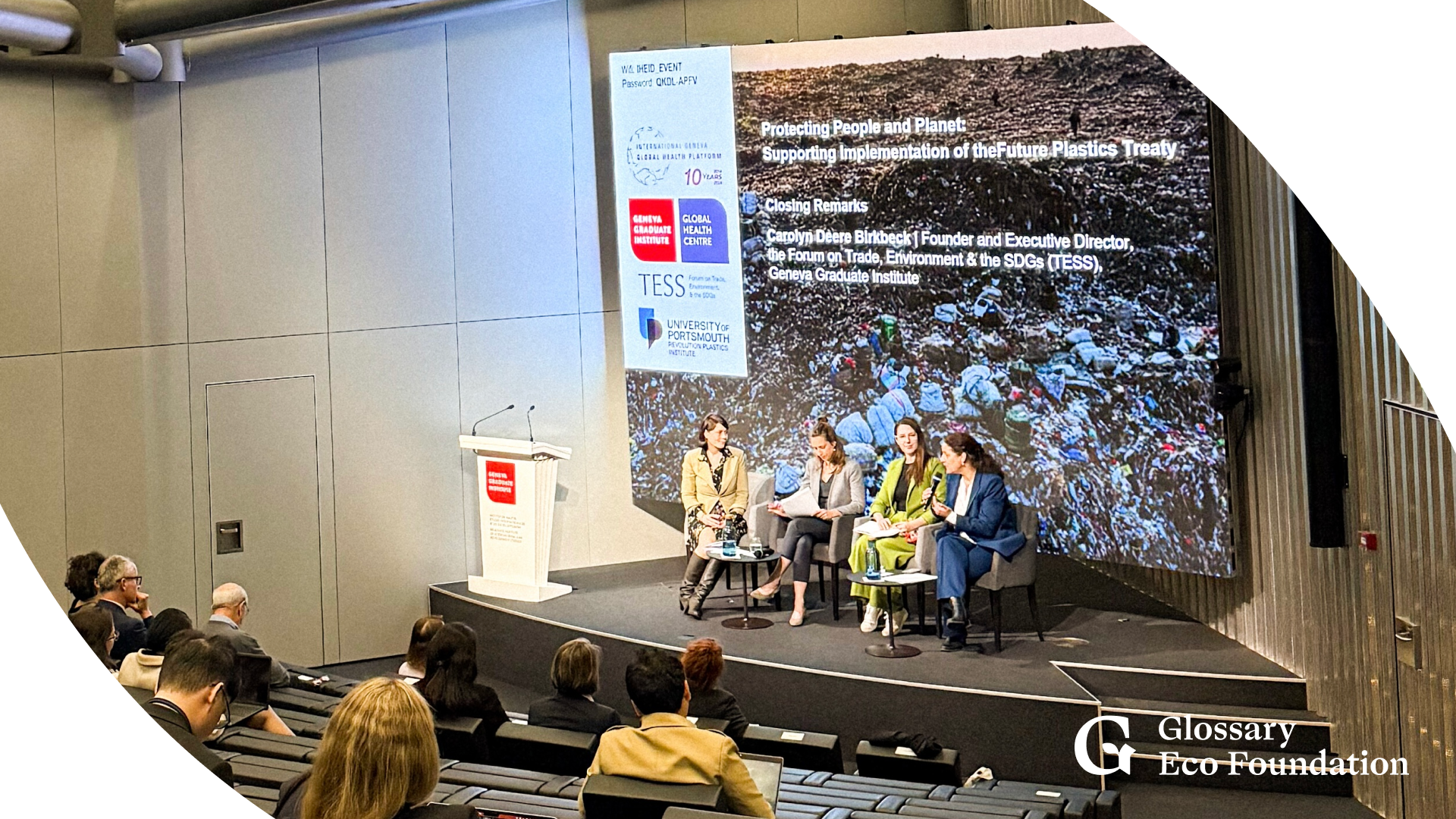


Anastasia Tsybulyak, a scientist, environmental activist, and founder of the Glossary Eco Foundation, participated in the Protecting People and Planet event in Geneva as part of Geneva Health Week 2025 and the 78th session of the WHO (WHA78). At the intersection of international law, health, and the environment, the future Plastics Treaty is being formed today. And the central position of the WHO (World Health Organization) is unequivocal: human health should be at the center of solving the plastic problem.
Plastic harms people — not just the environment.
Plastic is toxic at all stages of its life cycle: extraction, production, use, disposal. These are carcinogens, mutagens, endocrine disruptors. These are microplastics in the blood, lungs, and placenta. And even when we create art from waste — as in the video shown during the event — it does not solve the problem at a systemic level.
Legal framework for health protection.
During the meeting, a key element of the future treaty was discussed — Article 3, which should enshrine:
– a global ban on the most hazardous chemicals and products;
– a single international list of banned substances;
– update mechanisms in line with new scientific data;
– support for lower-income countries to make implementation possible for all.
94 countries have already supported these principles. Switzerland and Mexico are currently working on the article.
The health sector is no exception. An important thesis was heard at the event: the medical sector must also reduce its plastic footprint. There are already hospitals that are switching to alternatives. The WHO believes that blanket exemptions for medicine are not justified.
The public voice is key.
As Giulia Cavallini of the Center for International Environmental Law (CIEL) has pointed out, civil society is not just an “observer” of the negotiations. It is the bearers of scientific truth, human rights and environmental protection. And it is thanks to these voices that the mandate for the negotiations covers the entire life cycle of plastics. But here too it is important to distinguish: not all “non-governmental” are the same. Some are truly on behalf of the people. Others are representatives of business with an economic interest in maintaining the status quo.
Conflict of interest.
We cannot put on the same level those who represent communities, science, human rights – and those who have their own economic interests in maintaining the status quo. In this context, the WHO already has experience – for example, the Framework Convention on Tobacco Control, which clearly establishes the rules for interaction with the industry. Perhaps this is the approach that should be applied to environmental policy.
Message to negotiators:
Civil society will help implement a treaty – but not just any treaty. We should not ask people to defend a weak text that has no force. A strong treaty = real participation = real change.
Resources, equity and accountability
Who finances the transformation?
Why is it still the taxpayers who are responsible, not the producers? The polluter pays principle should be the basis for financing the implementation of the treaty. During one of the discussions on the future Treaty on Plastics, a very important provision from the WHO anti-tobacco convention was mentioned – Article 5.3, which is often called its “backbone”.
Why is this important?
Because any treaty that concerns health, the environment and industry must clearly distinguish:
— who represents the public interest,
— and who has its own commercial interests and is trying to influence policy.
It obliges states to openly report on their links with industry, limit the influence of commercial players on policy, and keep the public interest in focus.
What this means for Ukraine.
Ukraine is part of the global context. We are already feeling the effects of plastic pollution in our water, soil, and air. At the same time, we have a strong civil society, scientific expertise, and the will to change environmental policy. The future Plastics Treaty is a chance to set new principles for the economy and health. But only if the document is strong, legally binding, and truly people-oriented. Human health should not be somewhere on the periphery — but at the very center of the future plastics treaty.
Support Glossary Eco Foundation so we can continue educational and eco-friendly projects that make real difference
Donate